It’s Never Too Late for Science
Science Tuition for Adult Learners
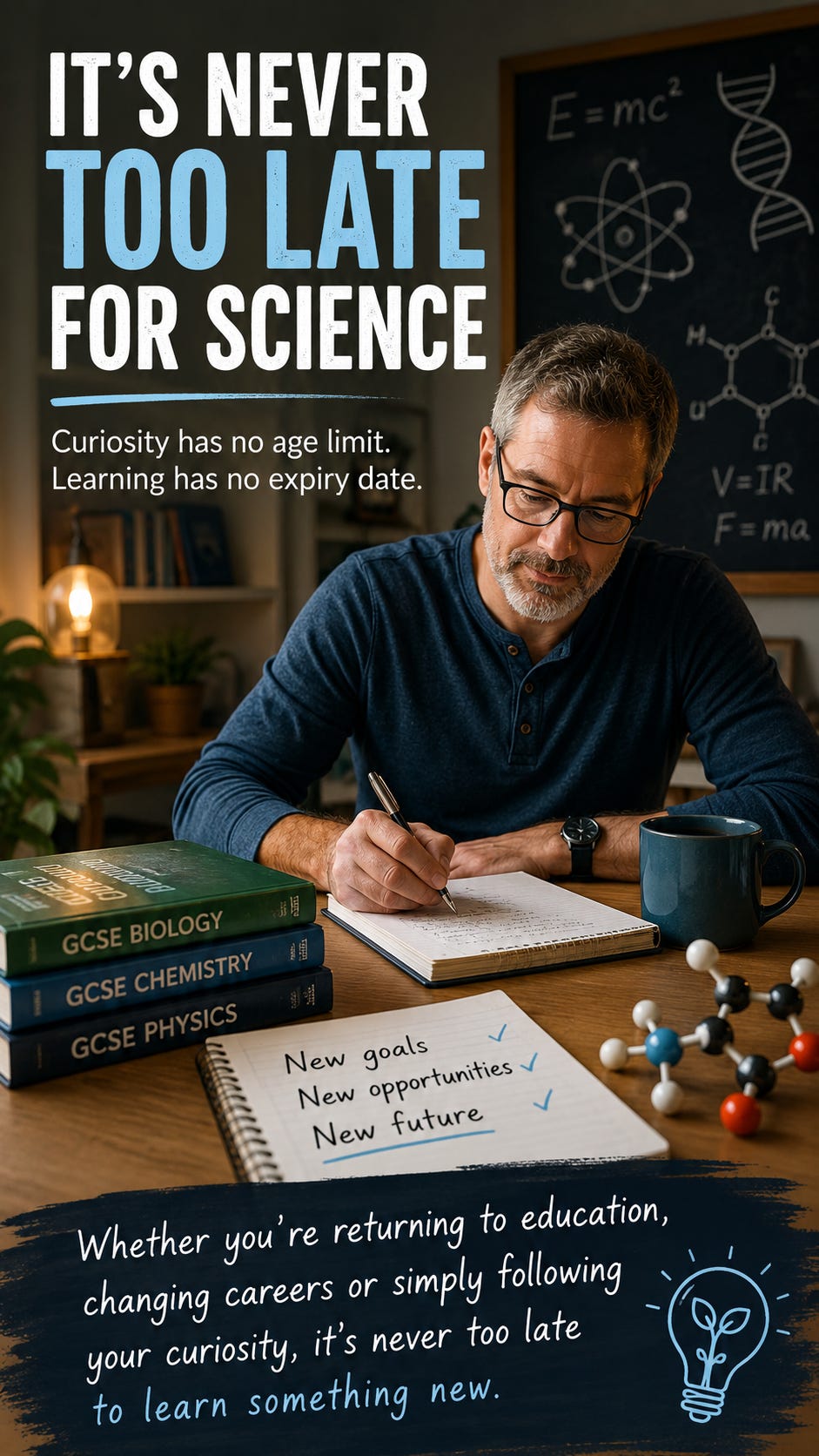
A curious thing happens to many people after they leave school.
They carry a version of themselves into adulthood that was created in a classroom years, sometimes decades, earlier. It is often an incomplete version, shaped by exam results, difficult lessons, moments of embarrassment, or subjects that simply never seemed to make sense at the time. Yet for many adults, those experiences become permanent conclusions. Somewhere along the way, they stop seeing them as events that happened and start seeing them as evidence of who they are.
This is particularly true when it comes to science.
It is remarkable how often adults will tell you, almost apologetically, that they were “never any good at science”. The statement is usually delivered with a laugh, as though it has become part of their personal identity. They may not have opened a science textbook in twenty years, but the judgement remains firmly in place. A disappointing exam result at sixteen somehow continues to influence how they see themselves at forty.
The problem, of course, is that life does not stand still. The person who sat in that classroom years ago is not the same person who exists today. Experience changes us. Confidence changes us. Responsibilities, careers, relationships and life itself reshape how we think about the world. Yet many people continue to measure their current abilities against a snapshot taken at a completely different stage of life.
Over the years, I have become increasingly convinced that the greatest obstacle facing many adult learners is not a lack of intelligence or ability. More often, it is the weight of assumptions they have carried for years. They arrive believing they are bad at science when, in reality, they may simply have encountered it at the wrong time, in the wrong environment, or through methods that never matched the way they learned best.
Recently, I was reminded of this when I was approached by an adult learner seeking science tuition. She was not preparing for school examinations under pressure from teachers or parents. She was pursuing her own goals and looking to strengthen her scientific understanding as part of a wider educational journey. What struck me most was not the request itself, but the fact that she had struggled to find science tuition specifically aimed at adults.
It is easy to see why this happens. Much of the tutoring world naturally focuses on children and teenagers. Schools generate a constant demand for support, and most educational services are built around that reality. Yet there is a growing community of adult learners returning to education for reasons that are every bit as important.
Some are preparing for GCSE qualifications they never completed first time around. Others are studying for Access to Higher Education courses, nursing qualifications, healthcare careers or university programmes. Some are changing careers entirely. Others simply want to understand science better because their curiosity never disappeared, even if formal education did.
What these learners often share is a willingness to begin again.
That willingness deserves more recognition than it usually receives. Returning to education later in life requires a particular kind of courage. It means revisiting subjects that may once have felt uncomfortable. It means risking failure in pursuit of something better. It means acknowledging that learning remains possible, even when society sometimes implies that our educational journeys should have been completed long ago.
In reality, learning has never worked according to such neat timelines. Human beings are naturally curious creatures. We ask questions from childhood onwards. We wonder how things work, why events happen, and what lies beneath the surface of the world around us. Science, at its heart, is simply a structured expression of that curiosity. It is not reserved for laboratories, universities or classrooms. It belongs to anyone interested in understanding a little more about the world they inhabit.
Perhaps this is why adult learners often bring something unique to the learning process. Unlike many younger students, they are usually there because they have chosen to be. Their motivation comes not from timetables or external expectations but from personal goals. There is often a sense of purpose behind their studies that can be both refreshing and inspiring.
This is particularly true for adults who are only now beginning to understand the role that neurodiversity may have played in their earlier educational experiences. Increasingly, adults are discovering that ADHD, autism, dyslexia, anxiety or other learning differences may have influenced how they experienced school. Some receive diagnoses later in life. Others simply begin to recognise patterns that help explain why certain educational environments felt difficult.
What many discover is that the problem was never a lack of ability. Often, it was a mismatch between the learner and the system. When teaching is adapted to suit the individual rather than expecting the individual to adapt to a rigid structure, entirely new possibilities can emerge. Concepts that once seemed confusing begin to make sense. Confidence gradually replaces self-doubt. Learning becomes less about proving oneself and more about understanding.
My own approach to education has been shaped significantly by more than a decade of teaching at Summerhill School, the internationally recognised democratic school founded by A.S. Neill. One lesson that has remained with me throughout that experience is that meaningful learning depends upon trust. People learn best when they feel safe enough to make mistakes, ask questions and explore ideas without fear of judgement.
Although that principle is often discussed in relation to children, it applies equally to adults. In some respects, it may matter even more. Adult learners frequently carry years of accumulated expectations and assumptions. Creating a calm, supportive environment where those assumptions can be challenged is often just as important as teaching the science itself.
Perhaps this is why I find adult education so encouraging. Every adult learner represents a small act of optimism. They are choosing growth over limitation. They are questioning old conclusions about themselves. They are proving that education is not something confined to a particular age or stage of life.
The modern world often encourages us to think in fixed categories. We are expected to decide who we are, what we are capable of, and what direction our lives should take. Yet reality is rarely so straightforward. People change careers. They develop new interests. They discover talents that were hidden for years. They return to ambitions they once abandoned.
Education should be flexible enough to accommodate that reality.
Science certainly should.
Whether someone is preparing for GCSE Science, considering a healthcare career, returning to formal education after many years away, or simply seeking a deeper understanding of the world around them, the opportunity to learn remains exactly where it has always been. Waiting patiently for curiosity to reopen the door.
The classroom may have been left behind many years ago, but the capacity to learn never disappears. In many cases, it simply waits for the right moment to return.
Science Tuition for Adult Learners
If you are an adult considering a return to science education, I now offer dedicated online science tuition for adult learners alongside my existing work with home-educated students and neurodivergent learners.
Whether you are preparing for GCSE Science, an Access course, a healthcare career, university study, or simply wish to build confidence in Biology, Chemistry or Physics, lessons are tailored to your goals and preferred learning style.
Learn more here:
https://thescienceguy.space/science-tuition-for-adult-learners/

Ready to make your next term easier and more successful? Discover the advantages of joining our online tutoring membership today and see how our community, hints, tips, and resources can make all the difference.
Plus my FREE Facebook Group:
Drop by my Website:
My TikTok Channel:
All of My Links in one place:
Thanks for reading The Science Guy!
Recommended FREE Reads: